

Introduction
A dump semi trailer is a self-unloading bulk material transport vehicle that uses a hydraulic system to tilt or lift its cargo body, discharging sand, gravel, coal, ore, or construction debris by gravity. Unlike a flatbed or van trailer that requires external handling equipment for unloading, the dump semi trailer carries its own discharge mechanism, reducing dependency on cranes, loaders, or tipping platforms at the destination.
For fleet managers and procurement teams, the dump semi trailer category encompasses distinct configurations with sharply different engineering priorities. A rear dump semi trailer tilts the body backward for discharge, suitable for conventional bulk materials and open tipping areas. A side dump semi trailer tilts laterally, enabling precise material placement along a windrow or discharge into narrow spaces where rear tipping is impractical. The hydraulic system that drives both configurations is the trailer’s most maintenance-intensive and safety-critical subsystem, and its specification—cylinder type, pressure rating, and control valving—determines discharge speed, reliability, and operating cost.
This guide examines the engineering and commercial factors that define dump semi trailer selection: hydraulic system design, structural durability under abrasive loads, payload and weight limits, and the maintenance practices that prevent hydraulic failure from becoming a roadside event.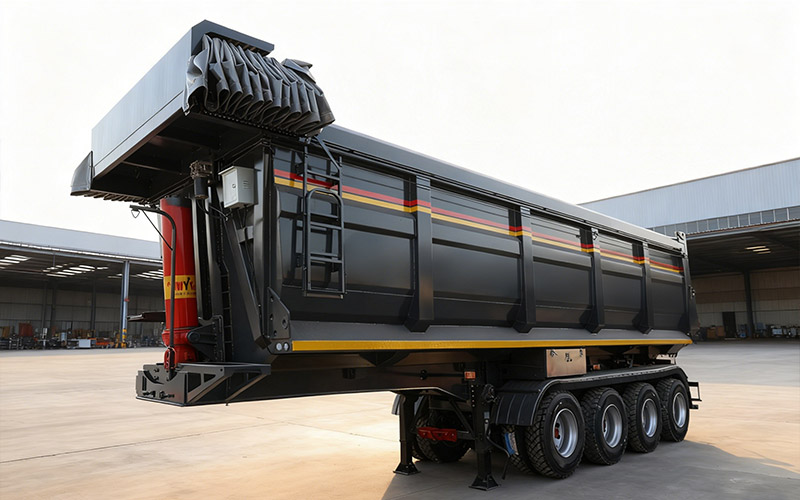
Core Powertrain and Structural Design
Engine and Transmission
A dump semi trailer has no engine or transmission. Its performance depends on the tractor’s hydraulic power take-off (PTO) or a self-contained hydraulic pump driven by the tractor’s electrical or mechanical system. The critical interface is the hydraulic supply: the tractor must provide sufficient flow and pressure to cycle the trailer’s cylinders within the required time window.
For PTO-driven systems, the tractor’s transmission must be in the correct gear and the PTO engaged before tipping begins. Some configurations use a 12V or 24V electric pump for smaller trailers, but heavy-duty dump semi trailers typically rely on PTO-driven hydraulic pumps to achieve the flow rates required for rapid discharge. The tractor’s hydraulic reservoir capacity and cooling must also be adequate for the heat generated during repeated tipping cycles.
Hydraulic System
The hydraulic system is the defining subsystem of a dump semi trailer. It consists of hydraulic cylinders, a pump, control valves, hoses, and safety devices including anti-overturn protection valves and emergency stop controls.
Cylinder configuration varies by trailer type. Rear dump trailers commonly use single or dual telescopic cylinders with lifting capacities in the 20–50 tonne range, operating at pressures of approximately 16–20 MPa for heavy-duty applications. Side dump trailers may use multiple cylinders (5+1 configurations are common) with lower operating pressure—sometimes cited as 100–150 PSI for certain designs, though this figure appears unusually low for heavy machinery and should be verified against the specific manufacturer’s specification.
Discharge time is a productivity metric. Rear dump semi trailers can complete discharge in 30 seconds to 2 minutes depending on cylinder size, pump flow, and material characteristics. Sticky materials such as wet clay require higher tipping angles—up to 60 degrees—to ensure complete discharge and minimize residual material.
Safety valves are not optional. An anti-overturn protection valve prevents the body from continuing to lift if the trailer becomes unstable, and an emergency stop button allows the operator to halt the tipping cycle immediately if a problem develops. These devices should be tested at every major service interval.
Chassis and Structural Durability
The dump semi trailer body is subjected to abrasive wear from sharp aggregates, impact loading from large rocks, and cyclic stress from repeated tipping cycles. High-manganese steel or wear-resistant plate (such as Hardox or AR450 grade) is commonly used for the body floor and side walls, with thicknesses ranging from 3–4 mm for standard duty to 6–8 mm for heavy-duty applications. Thinner plate reduces tare weight and increases payload, but wears faster under abrasive loads.
The main beams and cross-members must resist the torsional and bending loads imposed during tipping, when the body’s center of gravity shifts rearward or laterally. Reinforced cross-members and a rigid suspension system are typical for dump applications. The frame-to-body hinge points and the cylinder mounting structures are high-stress zones that should be inspected for cracks at every PM interval.
Technical Specifications
The table below presents representative parameters for rear and side dump semi trailers in construction and mining service. Values are labeled as typical industry ranges; actual specifications vary by manufacturer, model, configuration, and material density.
| Key Parameter | Typical Technical Specification | Operational Significance |
|---|---|---|
| Payload capacity | 25–45 t (standard); up to 100 t (heavy-duty side dump) | Determines material volume per trip; must align with legal axle limits |
| Body volume | 18–35 m³ (standard); up to 80 m³ (high-volume rear dump) | Volume-limited for light materials; weight-limited for dense aggregates |
| Hydraulic pressure | 16–20 MPa (PTO-driven heavy-duty systems) | Sufficient force to lift loaded body; lower pressure indicates pump or valve fault |
| Cylinder configuration | Single/dual telescopic (rear dump); 5+1 multi-cylinder (side dump) | Affects lifting force, discharge speed, and maintenance complexity |
| Discharge time | 30 seconds to 2 minutes | Productivity metric; sticky materials require longer cycle and higher angle |
| Dump angle | 45–60° (rear); up to 60° for sticky materials | Complete discharge and minimal residual material |
| Body plate thickness | 3–4 mm (standard); 6–8 mm (heavy-duty) | Abrasion resistance vs. tare weight trade-off |
| Axle configuration | Tandem (46k GVWR); tridem (65–80k GVWR) | Payload distribution and legal compliance |
Comparative Advantages TCO and ROI
The dump semi trailer competes with two alternatives: the rigid dump truck and the tipper trailer pulled by a dedicated tractor. The rigid dump truck offers superior maneuverability on confined construction sites and does not require a separate tractor, but its payload is constrained by a single chassis and it cannot be decoupled for waiting time. The dump semi trailer’s advantage is asset decoupling: the tractor can drop a loaded trailer at a discharge point and hook an empty unit, reducing tractor idle time in high-volume haulage operations.
Total cost of ownership for a dump semi trailer operation includes tractor acquisition, fuel, hydraulic maintenance, body wear, tires, and residual value. The hydraulic system is the largest maintenance cost driver after tires. A hydraulic failure that strands a loaded trailer on a construction site incurs not only.