

Overview
The different semi trailer types are defined by their cargo structure and loading method, and selecting the wrong one creates either underutilized capacity or a cargo that cannot be loaded, secured, or unloaded efficiently. For fleet managers and procurement teams, the central problem is that “semi trailer” describes a coupling arrangement, not a cargo capability—a dry van and a lowboy are both semi trailers, but they serve completely different freight profiles and have different legal constraints.
This FAQ addresses the dominant semi trailer types, their typical payload ranges, and the selection criteria that determine which configuration fits a given operation. Payload figures are presented as typical industry ranges; the trailer data plate and the manufacturer’s specification sheet control the specific purchase.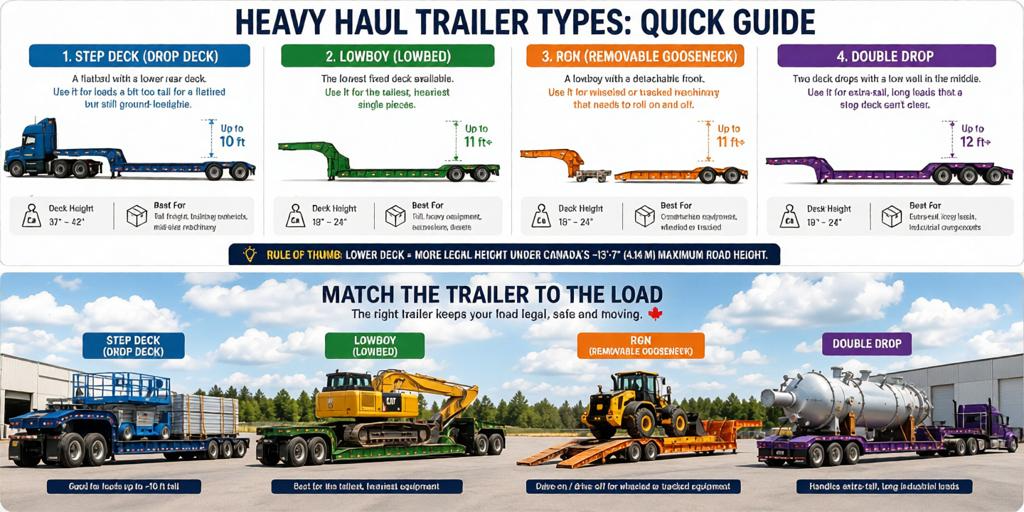
Frequently Asked Questions
What are the main different semi trailer types?
The main semi trailer types are dry van, refrigerated (reefer), flatbed, step deck, lowboy, tanker, dump, and car hauler, each defined by its cargo structure and loading method. A dry van is fully enclosed for general freight; a reefer adds insulation and a refrigeration unit for temperature control; a flatbed has an open deck for containers, steel, and machinery; a lowboy has a double-drop deck for tall equipment; a tanker carries liquids or bulk; a dump trailer unloads by gravity; and a car hauler uses a multi-level deck for vehicles .
The distinction matters at the procurement stage because the trailer’s structure determines what can be loaded from which direction, how cargo is secured, and what payload the unit can legally carry. A flatbed and a dry van of similar length may have materially different tare weights and legal payload ceilings.
What is a dry van semi trailer used for?
A dry van is the most common semi trailer type, used for general freight, palletized goods, and any cargo that requires weather protection but not temperature control. A standard 53-foot dry van carries approximately 26 standard pallets and has a legal payload of roughly 45,000 pounds .
The dry van is the workhorse of the North American truckload market, representing roughly 60 percent of the U.S. truckload market . Its interior height of 110 to 112 inches accommodates standard pallet stacks, and its enclosed body protects cargo from rain, road debris, and theft visibility. The dry van is the default choice for general freight unless the cargo requires temperature control or has physical dimensions that cannot pass through the door.
When should I choose a refrigerated semi trailer instead of a dry van?
Choose a refrigerated trailer when the cargo requires controlled temperature between approximately -20°F and +90°F, such as fresh produce, meat, pharmaceuticals, or frozen goods. A reefer carries a higher acquisition cost and operating cost than a dry van because of the refrigeration unit’s fuel consumption and maintenance requirements .
The reefer’s insulation reduces interior height by approximately 6 inches compared with a dry van, and the refrigeration unit consumes fuel and requires its own maintenance schedule. The reefer typically carries slightly less payload than a dry van of similar length—around 42,500 pounds legal payload—because the insulation and refrigeration equipment add tare weight . For fleets that only occasionally handle temperature-sensitive loads, subcontracting those shipments may be more economical than adding a reefer to the fleet.
What is a flatbed semi trailer best suited for?
A flatbed semi trailer is best suited for containers, steel products, construction materials, machinery, and oversized cargo that cannot be loaded into an enclosed body. A standard flatbed carries a maximum freight weight of approximately 48,000 pounds and has a deck height of about 60 inches .
Flatbeds are loaded from the top or side by crane or forklift, which makes them suitable for cargo that is too tall, too wide, or too irregular for a van trailer. The absence of side walls means load restraint depends entirely on straps, chains, and the deck’s tie-down points, so cargo securement competence is a fleet safety requirement. Twist locks are commonly fitted for container transport.
What payload can a lowboy semi trailer carry?
A lowboy semi trailer typically carries 40,000 pounds with two axles and up to 80,000 pounds or more with additional axles, depending on the configuration and the legal axle load limits on the route. The lowboy’s double-drop deck sits as low as 18 to 24 inches in the well section, allowing tall equipment to clear bridges and overpasses without height permits .
The lowboy is the appropriate choice when the cargo’s height or weight exceeds what a standard flatbed can legally or safely accommodate. The well length typically ranges from 24 to 29.6 feet, which constrains the footprint of the equipment that can be carried . The gooseneck configuration—fixed or removable—determines how the cargo is loaded.
What is the difference between an end dump and a side dump trailer?
An end dump trailer raises the front of the body hydraulically and discharges the load out the rear tailgate, while a side dump trailer tilts the body to one side to unload. End dumps are the most common configuration but carry a higher rollover risk because the raised body raises the center of gravity to its highest point. Side dumps offer greater stability on uneven ground and a faster dump cycle .
The choice depends on the site conditions and the material. End dumps are favored for their ability to place material in a concentrated pile and work in confined spaces. Side dumps are preferred where ground conditions are uneven or where the material needs to be placed along a windrow rather than in a pile. Bottom dump (belly dump) trailers unload from the bottom and are used for aggregate and asphalt where a continuous spread is required.
How do I choose the right semi trailer type for my operation?
Choose the trailer type by mapping the cargo’s physical form, loading method, protection requirement, and legal weight limits against the trailer’s structure. The decision sequence is:
-
Cargo form: Is it palletized, loose bulk, liquid, or a single oversized unit? This eliminates incompatible types immediately.
-
Loading method: Can the cargo be loaded from the rear only, or does it require side, top, or crane access?
-
Protection requirement: Does the cargo need weather protection, security, or temperature control?
-
Route and payload: What is the legal payload limit on the operating routes, and does the trailer’s tare weight leave adequate margin?
A fleet that handles a mix of palletized freight and containers may need both dry van and flatbed units rather than a single compromise specification. The trailer data plate and the manufacturer’s specification sheet remain the controlling references for every purchase.
Conclusion
The different semi trailer types are not interchangeable; each configuration’s cargo structure determines what it can load, how it protects the freight, and what payload it can legally carry. Dry vans serve general freight at roughly 45,000 pounds payload, reefers control temperature at a payload cost, flatbeds handle open-deck and container freight at around 48,000 pounds, and lowboys carry tall or heavy equipment with capacities from 40,000 to 80,000 pounds depending on axle count . The procurement decision should start from the cargo profile and loading environment, and every payload figure should be confirmed against the trailer data plate and the axle limits of the operating jurisdiction.