

Introduction
Reversing a tractor and semi trailer is one of the most demanding tasks in commercial truck operation. Tight delivery yards, loading docks, parked vehicles, pedestrians, limited visibility, and pressure to complete deliveries quickly all increase the risk of collisions and equipment damage. Safe reversing therefore requires more than steering skill: drivers must understand trailer movement, maintain situational awareness, and use a controlled procedure.
Backing a semi trailer safely starts with inspecting the reversing area, choosing the correct setup position, steering gradually, and making frequent observations. The most important principle is to move slowly enough to stop immediately whenever visibility or clearance becomes uncertain. Drivers should get out and look when necessary rather than attempting to reverse through an unseen hazard.
A semi trailer pivots around the fifth-wheel connection between the tractor and trailer. This articulation allows the combination to turn, but it also means the trailer does not follow the tractor's exact path. During reversing, small steering inputs can produce significant changes in trailer direction, especially when the tractor and trailer form a sharp angle.
The following techniques apply to common commercial combinations, including flatbed trailers, dry vans, refrigerated trailers, container chassis, and other conventional semi trailers. Exact procedures may vary with vehicle configuration, site conditions, and local safety requirements.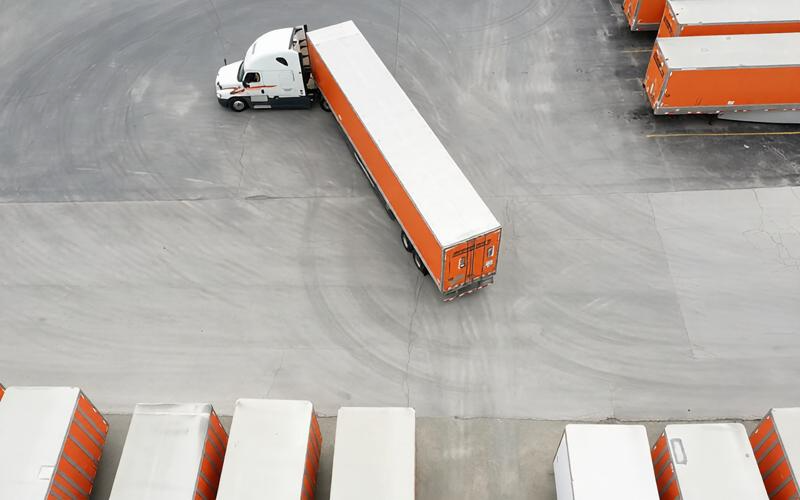
Core Powertrain and Structural Design
Although backing a semi trailer is primarily a driving and maneuvering task, understanding the tractor-trailer connection, steering system, braking equipment, and trailer geometry helps drivers control the vehicle more safely.
Engine and Transmission
During reversing, the tractor's engine and transmission provide the low-speed movement needed to position the trailer. The driver should use smooth throttle input and avoid sudden acceleration.
Many heavy-duty tractors have automated manual or automatic transmissions with a reverse gear and low-speed maneuvering characteristics. The correct operating method depends on the specific transmission and manufacturer's instructions.
Practical operating principles include:
-
Select the appropriate reverse gear before moving.
-
Use minimal, controlled throttle.
-
Avoid sudden changes between acceleration and braking.
-
Maintain a speed that allows an immediate stop.
-
Do not rely on engine power to push through resistance or an obstruction.
If the vehicle has an automated transmission, drivers should understand how its creep function, clutch engagement, and reverse response behave under load.
Hydraulic System
Most conventional semi trailers do not use a hydraulic system for ordinary reversing. However, some specialized trailers have hydraulic equipment, such as lifting platforms, steering axles, tipping bodies, or loading systems.
These systems should be secured in the correct travel position before the vehicle moves. A raised liftgate, unlocked hydraulic component, or improperly positioned steering axle can affect clearance and vehicle stability.
For ordinary backing operations, the main controls are the tractor steering wheel, transmission, service brakes, and parking brake.
Chassis, Fifth Wheel, and Structural Durability
The fifth wheel is the coupling mounted on the tractor that connects to the trailer kingpin. It allows the tractor and trailer to articulate during turning and reversing.
The angle between the tractor and trailer is often called the articulation angle. As this angle increases, the combination becomes more difficult to control. Excessive articulation can lead to jackknifing, where the tractor and trailer fold toward one another at an unsafe angle.
Drivers should understand three important characteristics:
-
Trailer pivot: The trailer changes direction around the fifth-wheel connection.
-
Off-tracking: The trailer wheels follow a different path from the tractor's front wheels during a turn.
-
Jackknife risk: Excessive tractor-trailer articulation can cause loss of control or vehicle damage.
A trailer's wheelbase, axle position, overall length, and rear overhang influence its reversing behavior. Longer trailers may require more space to reposition, while different axle configurations can change how the trailer responds to steering inputs.
Operator Safety and Visibility
Mirrors are essential for reversing a semi trailer, but they do not eliminate blind spots. Trailer sides, tractor bodywork, nearby vehicles, dock structures, and cargo can block the driver's view.
Depending on the vehicle, visibility equipment may include:
-
Large side mirrors and convex mirrors.
-
Rear-view cameras.
-
Proximity sensors.
-
Reversing alarms.
-
Trailer-mounted camera systems.
Electronic aids can improve awareness, but they should not replace direct observation and safe driving procedures.
Drivers should also know the site-specific reversing rules. Some facilities require a spotter, designated reversing routes, high-visibility clothing, or the use of warning systems before entering a loading area.
Technical Specifications
There is no single technical specification for backing a semi trailer because reversing behavior depends on the tractor, trailer dimensions, coupling geometry, axle configuration, visibility equipment, and operating environment. The following parameters are useful when assessing maneuverability and planning reversing operations.
|
Key Parameter |
Typical Technical Specification |
Operational Significance |
|---|---|---|
|
Trailer length |
Varies by trailer type and local regulations |
Longer trailers generally require more maneuvering space |
|
Trailer width |
Commonly around 2.5–2.6 m in many markets |
Determines side clearance in narrow areas |
|
Trailer axle configuration |
Tandem, tridem, or other approved arrangements |
Influences tracking, turning, and load distribution |
|
Fifth-wheel connection |
Kingpin coupled to tractor fifth wheel |
Provides the pivot for articulation |
|
Tractor steering |
Front-wheel steering |
Controls tractor direction and trailer articulation |
|
Reverse transmission |
Vehicle-specific reverse gear and control system |
Determines low-speed movement and response |
|
Visibility equipment |
Mirrors, cameras, and optional sensors |
Helps drivers monitor blind areas and obstacles |
|
Braking system |
Typically pneumatic service brakes, with ABS or EBS where equipped |
Provides controlled stopping during maneuvering |
These are general industry characteristics, not specifications for a particular trailer model. Actual dimensions, coupling geometry, and equipment vary by manufacturer and configuration.
For fleet managers, trailer length and axle layout are especially relevant when assigning vehicles to delivery sites. A trailer that is suitable for highway transportation may still be difficult to reverse into a restricted loading bay.
Comparative Advantages TCO and ROI
A controlled reversing procedure can reduce the likelihood of collisions, damaged equipment, delivery delays, and avoidable maintenance expenses. Compared with rushed or inconsistent maneuvering, a standardized process gives drivers more opportunities to identify hazards before they become incidents.
Controlled Reversing Versus Rushed Maneuvering
A driver who reverses quickly may complete a maneuver in less time under ideal conditions. However, limited visibility and delayed reactions can increase the risk of hitting dock equipment, parked vehicles, loading structures, or pedestrians.
A slower, deliberate procedure offers several advantages:
-
More time to observe trailer movement.
-
Better control of articulation angle.
-
Earlier identification of obstacles.
-
Reduced risk of tire, bumper, and body damage.
-
Fewer interruptions caused by corrective repositioning.
The goal is not to reverse as slowly as possible in every situation, but to maintain a speed appropriate to visibility, available space, and hazard exposure.
Reversing Cameras and Spotters
Reversing cameras can provide a view of areas that are difficult to see through conventional mirrors. A trained spotter can also help guide the driver through confined spaces.
However, both methods have limitations. Cameras can become obstructed by dirt, rain, or poor lighting. A spotter can move out of view or be exposed to vehicle movement.
A safe procedure should establish clear communication signals and require the driver to stop if the spotter disappears from sight or instructions become unclear.
Total Cost of Ownership and ROI
The financial impact of reversing practices can be evaluated through the cost of incidents, repairs, downtime, and driver training.
For example, a fleet could compare two reversing-training approaches over a defined period using the following assumptions:
-
The same number of vehicles and drivers.
-
Comparable delivery routes and site conditions.
-
Recorded reversing-related damage and downtime.
-
Actual training and equipment costs.
-
Consistent reporting of minor and major incidents.
The fleet can then compare total training and equipment expenditure with changes in repair costs, insurance-related expenses, and vehicle downtime.
No fixed savings figure should be assumed. Results depend on the fleet's previous incident rate, driver experience, facility layout, and quality of training.
Heavy Duty Application Scenarios
Backing a semi trailer is required in many commercial transport environments. Each setting creates different visibility, space, and maneuverability challenges.
Loading Docks and Distribution Centers
Loading docks often require drivers to reverse into narrow bays while maintaining alignment with dock bumpers and doors.
Useful practices include:
-
Check the dock position before approaching.
-
Confirm that the loading bay is available.
-
Identify pedestrians, forklifts, and dock workers.
-
Align the tractor and trailer as much as possible before reversing.
-
Use small steering corrections to maintain the intended path.
-
Stop and reassess if the trailer approaches the dock at an unsafe angle.
Truck Yards and Freight Terminals
Truck yards may contain parked trailers, moving tractors, forklifts, and workers. Drivers should use designated traffic routes and avoid reversing across active pedestrian areas.
When moving between parked trailers, pay particular attention to side clearance, trailer corners, landing gear, and nearby equipment.
Construction Sites
Construction sites often have uneven surfaces, temporary roads, limited turning areas, and changing obstacles. Ground conditions may also affect traction and braking.
Drivers should check for:
-
Soft ground and unstable shoulders.
-
Excavation areas and drainage channels.
-
Construction materials and temporary barriers.
-
Overhead cables and structures.
-
Workers and mobile construction equipment.
A spotter may be necessary where visibility is restricted or site rules require one.
Retail and Urban Deliveries
Urban delivery locations often have narrow streets, parked cars, pedestrians, cyclists, and limited room for repositioning.
Drivers should avoid entering a reversing maneuver unless the exit path and required clearance are understood. Where possible, use a designated loading area and follow local traffic and site instructions.
Container Terminals and Industrial Facilities
Container chassis and industrial trailers may have different lengths, axle layouts, and rear structures. Drivers should account for twist-lock equipment, container corners, chassis components, and terminal traffic.
At facilities with specialized reversing procedures, drivers should follow the terminal's instructions and any designated communication protocol.
Selection and Maintenance Considerations
Safe reversing depends on driver competence, vehicle condition, visibility equipment, and the layout of the operating site. Fleet managers should treat reversing as a repeatable safety process rather than relying entirely on individual experience.
12 Practical Tips for Backing a Semi Trailer
1. Inspect the area first. Before reversing, check the complete path for pedestrians, vehicles, dock structures, overhead hazards, and uneven ground.
2. Plan the maneuver. Identify the target position, approach direction, available turning space, and possible exit route before moving.
3. Get out and look. If the rear or side clearance is uncertain, stop, secure the vehicle, and inspect the area on foot. Repeat this check whenever conditions change.
4. Start with the straightest possible alignment. A straighter approach usually makes trailer movement easier to predict and reduces the need for large steering corrections.
5. Understand the trailer's pivot. Remember that the trailer turns around the fifth-wheel connection rather than following the tractor's front wheels directly.
6. Use small steering inputs. Make gradual corrections and allow time for the trailer to respond. Avoid abrupt movements.
7. Watch both mirrors. Monitor the trailer's position on both sides and alternate observations frequently. Do not focus on only one mirror for an extended period.
8. Reverse slowly. Use controlled movement so that you can stop immediately if an obstacle appears or the trailer moves away from the intended path.
9. Avoid excessive articulation. Do not allow the tractor and trailer to form an unnecessarily sharp angle. Excessive articulation increases jackknife risk.
10. Use a spotter when appropriate. Agree on clear signals before moving. Stop immediately if the spotter disappears from view or communication is lost.
11. Use cameras and sensors as supporting tools. Keep camera lenses clean and remember that electronic systems may not detect every obstacle.
12. Stop and reset when necessary. Pull forward to improve alignment instead of forcing a difficult maneuver. Repositioning is safer than continuing when the trailer angle or clearance becomes uncertain.
Common Reversing Mistakes
Some reversing problems are caused by predictable driver errors. Common examples include:
-
Steering too sharply and creating excessive articulation.
-
Looking at only one mirror.
-
Reversing too quickly for the available visibility.
-
Failing to inspect the rear of the trailer.
-
Continuing after losing sight of a spotter.
-
Assuming a reversing camera shows the entire surrounding area.
-
Ignoring pedestrians or moving equipment.
-
Trying to correct a poor approach without repositioning the tractor.
Correcting these habits through training and consistent supervision can improve reversing safety.
Preventive Vehicle Maintenance
Vehicle condition also influences reversing control. Fleet maintenance programs should include regular inspection of:
-
Steering components and front suspension.
-
Fifth-wheel locking mechanism and kingpin.
-
Tractor and trailer braking systems.
-
Tires, wheel fasteners, and suspension components.
-
Mirrors, camera systems, and reversing alarms.
-
Electrical connections and trailer lighting.
-
Air lines and pneumatic connections.
Any abnormal steering response, brake issue, coupling defect, or damaged visibility equipment should be reported and addressed before the vehicle returns to service.
Driver Training and Site Procedures
Training should include both classroom instruction and supervised practical exercises. Drivers need to understand trailer articulation, off-tracking, blind spots, and the relationship between tractor steering and trailer movement.
A useful training program should cover:
-
Straight-line reversing.
-
Reversing into a marked loading bay.
-
Offset reversing where permitted and appropriate.
-
Mirror adjustment and observation routines.
-
Spotter communication.
-
Safe stopping and repositioning.
-
Emergency procedures and site-specific hazards.
Training exercises should take place in a controlled area with adequate clearance and supervision. Drivers should not practice difficult maneuvers in active traffic or crowded loading zones.
Conclusion
Backing a semi trailer safely depends on preparation, controlled steering, low-speed movement, frequent observation, and an understanding of trailer articulation. Drivers should inspect the reversing area, establish a clear maneuvering plan, use mirrors and cameras correctly, and stop whenever visibility or clearance becomes uncertain.
For fleet operators, consistent reversing procedures, practical driver training, suitable visibility equipment, and regular vehicle maintenance can help reduce collision risks and avoidable downtime. The most reliable approach is to prioritize control and awareness over speed, using repositioning or a spotter whenever the maneuver cannot be completed safely from the driver's available view.