

Introduction
Transporting construction machinery, agricultural equipment, and industrial vehicles requires loading systems that combine sufficient strength, reliable traction, and practical handling. Aluminum semi trailer ramps provide a lightweight alternative to many conventional steel ramp designs, allowing operators to load wheeled or tracked equipment onto trailers while managing overall vehicle weight.
These ramps are commonly used with equipment trailers, flatbed trailers, lowbed trailers, and other specialized transport platforms. Depending on the design, they may be removable, folding, sliding, or permanently mounted. Their primary function is to create a controlled transition between ground level and the trailer deck.
Aluminum offers a favorable strength-to-weight ratio and natural corrosion resistance. Reducing ramp weight can make handling easier and may help preserve the trailer's available payload capacity. However, lightweight construction does not automatically mean that a ramp is suitable for every machine. Load rating, support geometry, ramp length, width, surface traction, and attachment security must all match the intended equipment.
For fleet managers, contractors, equipment rental companies, and trailer manufacturers, selecting the correct aluminum semi trailer ramps is an important part of loading safety and transport efficiency.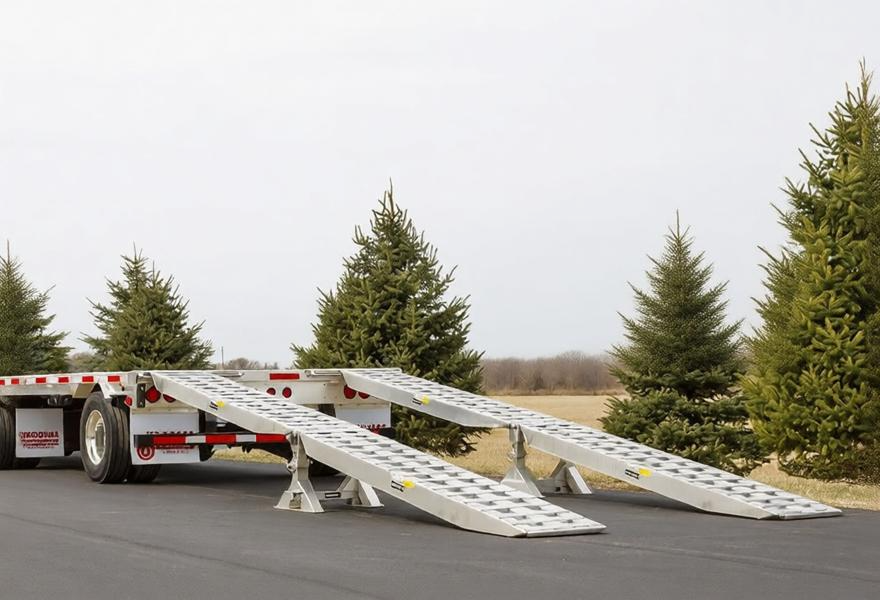
Core Powertrain and Structural Design
Aluminum semi trailer ramps do not have an independent engine, transmission, or hydraulic powertrain in their basic configuration. Their performance depends primarily on structural engineering, material properties, support arrangements, and the connection between the ramp and trailer.
Aluminum Material and Structural Design
Aluminum alloys are widely used in transport equipment because they combine relatively low density with useful mechanical strength and corrosion resistance.
Ramp manufacturers may use structural aluminum extrusions, welded sections, reinforced channels, and crossmembers to create a load-bearing platform. The exact alloy, temper, section geometry, and manufacturing process determine the mechanical properties of the finished ramp.
Important structural elements include:
-
Main longitudinal beams that carry the primary bending loads.
-
Crossmembers that distribute loads across the ramp width.
-
Reinforced end sections and support points.
-
Side rails or edge protection where required.
-
Traction surfaces that provide grip for tires or tracks.
-
Connection plates and locking components.
The design must account for bending, shear, local deformation, fatigue, and repeated impact during equipment loading. A ramp's appearance or material thickness alone cannot establish its safe working load.
Ramp Surface and Traction Design
The ramp surface must provide sufficient traction under the expected operating conditions. Common designs include extruded traction profiles, raised crossbars, serrated surfaces, and other anti-slip patterns.
Surface selection should consider the equipment's tire or track design, loading angle, weather exposure, and potential contamination from mud, oil, water, or loose materials.
For tracked machinery, the surface must support concentrated contact loads from the track shoes. For wheeled machinery, tire contact pressure and the possibility of wheel slip should be considered.
A ramp that performs well in dry conditions may become more difficult to use when wet or contaminated. Operators should inspect the traction surface regularly and remove material that could reduce grip.
Chassis, Ramp Supports, and Connection System
The trailer connection is a critical part of the complete loading system. Aluminum ramps may rest on reinforced deck edges, engage with dedicated mounting brackets, or use manufacturer-designed locking mechanisms.
The support arrangement must transfer the ramp load into the trailer structure without creating excessive local stress.
Key design considerations include:
-
Ramp-to-deck engagement length.
-
Support bearing area.
-
Retaining pins or locking mechanisms.
-
Ramp alignment and lateral stability.
-
Trailer deck strength at the support location.
-
Resistance to movement during loading.
-
Compatibility with the trailer's rear structure.
A ramp should never be used with an improvised connection that has not been approved for the intended loading arrangement.
Folding, Sliding, and Removable Ramp Mechanisms
Aluminum semi trailer ramps are available in several configurations.
Removable ramps can be detached and stored when they are not required. They are suitable for operations where loading equipment varies or where rear clearance must be maintained.
Folding ramps use hinges and locking components to reduce storage requirements. Their hinge assemblies and locking devices require regular inspection.
Sliding ramps move into storage positions along a designed support system. Their guides, rollers, and locking arrangements must remain properly aligned and functional.
Fixed ramps provide a permanent loading surface and may be suitable for specialized trailers with frequent loading requirements.
The correct arrangement depends on loading frequency, available storage space, operator handling requirements, and the trailer's structural configuration.
Operator Safety and Serviceability
Ramp safety depends on more than the ramp itself. The loading area, trailer stability, equipment condition, and operator procedures all influence the risk of an incident.
The trailer should be positioned on firm, reasonably level ground with its parking and support systems correctly engaged. Operators should verify that ramps are fully seated and secured before equipment begins climbing.
Ramp edges, support points, hinges, welds, and locking mechanisms should remain accessible for inspection. Damaged or deformed components should be removed from service until evaluated and repaired by qualified personnel.
Technical Specifications
The specifications of aluminum semi trailer ramps vary according to their intended equipment class, ramp length, width, structural design, and support arrangement. Buyers should evaluate the complete ramp assembly rather than selecting a product based only on its aluminum thickness or advertised weight.
The following table identifies the principal parameters used in ramp selection. Actual ratings must be confirmed through manufacturer documentation.
|
Key Parameter |
Typical Technical Specification |
Operational Significance |
|---|---|---|
|
Material |
Structural aluminum alloy |
Influences strength, weight, and corrosion resistance |
|
Ramp load rating |
Manufacturer-rated working load |
Determines compatible equipment weight |
|
Ramp length |
Configuration-dependent |
Controls loading angle and approach clearance |
|
Ramp width |
Single or paired ramp configuration |
Must accommodate tire or track width |
|
Structural design |
Extruded sections, beams, and crossmembers |
Determines load distribution and stiffness |
|
Surface design |
Serrated, raised, or traction-profile surface |
Helps reduce tire or track slippage |
|
Connection system |
Hook, bracket, pin, or approved mounting interface |
Maintains secure contact with trailer deck |
|
Ramp configuration |
Fixed, folding, sliding, or removable |
Affects storage and loading convenience |
Load Capacity and Weight Distribution
The rated working load is the maximum load permitted under the manufacturer's specified conditions. It should not be confused with the weight of the equipment alone.
When calculating the required ramp capacity, buyers must consider how the machine's weight is distributed during loading. The load may not be shared equally between two ramps, particularly when equipment turns, climbs at an angle, or has an uneven center of gravity.
For tracked equipment, track contact length and shoe geometry affect how the load is transferred into the ramp. For wheeled equipment, axle loads and tire positions must be considered.
The selected ramp system must be rated for the actual loading configuration, including any applicable dynamic or impact effects defined by its manufacturer.
Ramp Length and Loading Angle
Ramp length directly influences the angle between the ground and trailer deck. A longer ramp generally creates a shallower approach angle, which can improve loading conditions for low-clearance equipment.
A simplified geometric relationship is:
Where:
-
\(\theta\) = ramp angle.
-
\(H\) = vertical height of the trailer deck above the ground.
-
\(L\) = horizontal projection of the ramp.
The actual ramp geometry, effective length, ground conditions, and trailer support arrangement should be considered when evaluating the loading angle.
Ramp Width and Equipment Compatibility
Ramp width must accommodate the equipment's tire or track configuration with sufficient clearance for controlled movement.
Buyers should confirm:
-
Overall tire or track width.
-
Distance between the equipment's wheels or tracks.
-
Ground clearance and undercarriage geometry.
-
Position of the machine's center of gravity.
-
Whether the equipment can travel straight up the ramps.
-
Whether the ramp surface provides suitable traction.
The ramp system must also fit the trailer's deck width and rear mounting arrangement.
Comparative Advantages TCO and ROI
Aluminum semi trailer ramps are often compared with steel ramps. Both materials can provide suitable loading systems when properly engineered, but their weight, durability, handling requirements, and maintenance characteristics differ.
Aluminum Ramps vs. Steel Ramps
Aluminum's main commercial advantage is its lower density. For comparable structural requirements, an appropriately engineered aluminum ramp assembly may weigh less than a steel alternative.
This can reduce manual handling effort and help preserve the trailer's available payload capacity. However, steel may be preferable in certain high-impact or demanding applications, depending on the structural design and maintenance requirements.
|
Evaluation Factor |
Aluminum Ramps |
Steel Ramps |
|---|---|---|
|
Weight |
Generally lighter for comparable applications |
Generally heavier |
|
Corrosion behavior |
Naturally forms a protective oxide layer |
Usually requires suitable coatings or corrosion protection |
|
Handling |
Often easier to move manually |
May require more handling effort |
|
Structural design |
Requires careful alloy and section selection |
Offers a wide range of established structural designs |
|
Impact resistance |
Depends on alloy, geometry, and impact conditions |
Depends on steel grade and construction |
|
Maintenance |
Inspection of welds, deformation, and connections |
Inspection of welds, coatings, corrosion, and connections |
|
Purchase cost |
Can involve higher material or fabrication costs |
Varies by steel grade and manufacturing process |
Neither material is universally superior. The best choice depends on rated capacity, loading frequency, operating environment, available budget, and the trailer's payload requirements.
Total Cost of Ownership
The total cost of ownership (TCO) of a ramp system includes more than its purchase price. Fleet operators should consider:
-
Initial ramp purchase cost.
-
Installation and mounting expenses.
-
Handling and storage requirements.
-
Inspection and maintenance costs.
-
Repair or replacement of damaged components.
-
Downtime caused by unavailable loading equipment.
-
Effects of ramp weight on trailer payload capacity.
Aluminum ramps may reduce handling effort and improve payload flexibility where ramp weight is a significant factor. However, the financial benefit depends on actual operating conditions and the structural suitability of the selected product.
ROI and Operational Efficiency
A practical ROI evaluation should compare the total operating cost of aluminum ramps with an alternative ramp system over the expected ownership period.
For example, a fleet replacing steel ramps with aluminum ramps could evaluate the reduction in handling time, changes in trailer tare weight, additional payload opportunities, and differences in maintenance expenses.
The calculation should use consistent assumptions for annual loading frequency, equipment weight, route distance, freight revenue per unit of payload, labor cost, and expected ramp service life.
A lighter ramp does not automatically generate additional revenue. The trailer must have sufficient legal weight capacity, and the transported cargo must be available to use any payload capacity gained.
Heavy Duty Application Scenarios
Aluminum semi trailer ramps are suitable for a range of equipment-loading applications when their ratings, dimensions, and mounting systems match the intended machinery.
Construction Equipment Transportation
Construction contractors and equipment rental companies frequently transport compact machinery between job sites.
Typical equipment includes:
-
Mini excavators.
-
Skid steer loaders.
-
Compact track loaders.
-
Small wheel loaders.
-
Compact rollers.
-
Other wheeled or tracked construction machines.
The ramp system should accommodate the machine's operating weight, track or tire geometry, ground clearance, and approach angle.
Agricultural Machinery Transport
Agricultural operations may use aluminum ramps to load tractors, compact harvesters, utility vehicles, and other mobile machinery.
Equipment dimensions and tire configurations vary significantly, so buyers should confirm the actual axle loads and contact positions before selecting a ramp.
Mud, soil, and crop residue can reduce surface traction. Regular cleaning and inspection are particularly important for agricultural applications.
Industrial and Warehouse Equipment
Aluminum ramps can also support the loading of industrial vehicles and mobile equipment, including certain forklifts, compact material-handling machines, and maintenance vehicles.
The loading arrangement should be evaluated carefully because forklifts and other industrial vehicles can have concentrated axle loads that differ substantially from their overall operating weight.
Vehicle and Trailer Logistics
Specialized trailers may use aluminum loading ramps for transporting cars, utility vehicles, and other wheeled equipment.
The ramp angle, surface grip, width, and approach clearance are important for low-clearance vehicles. Folding or sliding ramp configurations may be useful where storage space is limited.
Heavy Equipment Rental Fleets
Rental companies often transport different machine types throughout the week. A removable or adjustable ramp arrangement may provide operational flexibility if the system is approved for the intended load range and equipment dimensions.
For mixed fleets, ramp selection should be based on the heaviest approved loading configuration rather than the average machine weight.
Selection and Maintenance Considerations
Selecting aluminum semi trailer ramps requires a detailed review of equipment weight, ramp geometry, trailer compatibility, operating frequency, and loading conditions.
Equipment Selection
Before purchasing, procurement teams should confirm:
-
Equipment weight: Identify the machine's operating weight, including attachments, fuel, and other installed equipment.
-
Load distribution: Check axle loads, track contact geometry, and the expected load on each ramp.
-
Rated capacity: Select a ramp system with a manufacturer-approved rating for the complete loading arrangement.
-
Ramp length: Confirm that the ramp provides a suitable approach angle for the equipment.
-
Ramp width: Ensure sufficient clearance for tires or tracks.
-
Surface traction: Choose a suitable profile for the equipment and expected weather conditions.
-
Mounting compatibility: Verify that the ramp connections match the trailer's rear structure.
-
Storage configuration: Compare removable, folding, sliding, and fixed designs.
-
Manufacturer support: Review technical drawings, load-rating documentation, warranty terms, and replacement-part availability.
Preventive Maintenance
Aluminum ramps require routine inspection even though aluminum naturally resists many forms of atmospheric corrosion.
A practical maintenance program should include:
-
Inspecting main beams and crossmembers for bending or deformation.
-
Checking welds for cracks or visible damage.
-
Examining mounting hooks, pins, hinges, and locking devices.
-
Checking traction surfaces for excessive wear or damage.
-
Removing mud, oil, and other slippery contamination.
-
Inspecting support points for local crushing or deformation.
-
Checking for galvanic corrosion where aluminum contacts dissimilar metals.
-
Verifying that the ramp remains correctly aligned with the trailer deck.
Maintenance intervals should reflect loading frequency, machine weight, operating environment, manufacturer recommendations, and observed wear.
Any ramp showing structural cracks, significant permanent deformation, or damaged locking components should be removed from service pending a qualified assessment.
Safe Loading Procedures
Safe loading requires correct equipment positioning and a stable trailer.
Operators should:
-
Park the trailer on firm, level ground where practical.
-
Apply the parking brake and engage the trailer's support systems as required.
-
Install and secure ramps according to the manufacturer's instructions.
-
Confirm that both ramps are correctly seated and aligned.
-
Check the loading surface for mud, oil, loose material, or other hazards.
-
Approach slowly and maintain a controlled, straight path.
-
Avoid sudden steering, acceleration, or braking while climbing.
-
Secure the loaded equipment using suitable transport restraints.
Personnel should remain clear of the ramp path and avoid standing directly behind or beneath equipment during loading.
Supplier and Manufacturer Evaluation
A reliable ramp supplier should provide technical information that allows buyers to verify product suitability.
Request:
-
Ramp dimensions and structural drawings.
-
Material and alloy information.
-
Rated working load and applicable loading conditions.
-
Ramp weight and mounting details.
-
Inspection and maintenance instructions.
-
Warranty coverage.
-
Replacement components and after-sales support.
For custom aluminum semi trailer ramps, the manufacturer should review the trailer deck structure and the actual machinery loading requirements before finalizing the design.
Conclusion
Aluminum semi trailer ramps provide a lightweight loading solution for transporting construction machinery, agricultural equipment, industrial vehicles, and other mobile cargo. Their low weight and corrosion resistance can offer practical advantages, particularly for fleets that handle ramps frequently or need to manage trailer tare weight.
However, safe performance depends on more than material selection. Rated load capacity, ramp length, width, structural design, surface traction, support geometry, and secure trailer connections must all match the intended equipment and loading conditions.
For equipment buyers and fleet managers, the most effective purchasing decision is based on verified load ratings, compatibility with the trailer, practical handling requirements, maintenance support, and total cost of ownership. Properly selected and maintained aluminum semi trailer ramps can improve loading efficiency while supporting reliable, long-term trailer operations.