

Introduction
Heavy-haul fleet operators face a persistent squeeze between rising payload demands and the need to control fuel, maintenance, and downtime costs. For bulk cargo applications that require both weather protection and rapid side access, the 80-ton efficient durable bulk curtain side semi trailer has emerged as a specialized solution. This equipment class combines a reinforced chassis rated for extreme payloads with a flexible curtain superstructure that permits forklift loading from either side, reducing warehouse turnaround time compared with rigid box trailers.
A curtain side semi trailer replaces rigid side walls with a tensioned flexible curtain mounted on sliding or fixed posts. In the 80-ton class, the trailer is typically configured with four axles to distribute the concentrated load of dense bulk materials such as steel coil, bagged minerals, construction aggregates, or heavy palletized goods. The engineering challenge lies in balancing the weight penalty of a heavy-duty chassis against the payload target while maintaining curtain tension, weather sealing, and structural integrity under dynamic loading.
This article examines the powertrain and structural considerations specific to this equipment class, presents typical specification ranges where verified model data is unavailable, and evaluates the commercial case against alternative trailer types. All figures are presented as industry ranges unless otherwise qualified; actual specifications vary by manufacturer, configuration, duty cycle, and local regulations.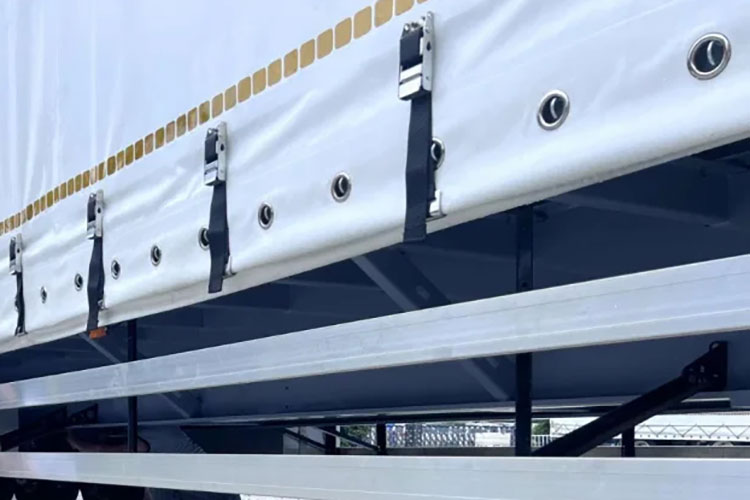
Core Powertrain and Structural Design
Chassis and Running Gear
The foundation of an 80-ton curtain side trailer is a heavy-duty welded steel chassis. Main beams are typically fabricated from high-strength steel, with deep I-beam profiles to resist bending moments under concentrated loads. For this payload class, manufacturers commonly specify four axles with 13-ton or 16-ton capacity ratings per axle, often from established component suppliers such as FUWA or BPW. The axle count directly affects load distribution: spreading 80 tons across four axles reduces per-axle loading compared with a three-axle configuration, which is critical for compliance with road traffic regulations in most jurisdictions.
Suspension choice influences both durability and cargo protection. Heavy-duty mechanical spring suspension is common in this segment for its simplicity and repairability in remote operating environments, while air suspension offers load-leveling capability and reduced shock transmission to sensitive cargo. The trade-off involves maintenance complexity and cost: air systems require compressor and valve servicing, whereas mechanical systems demand periodic inspection of leaf springs, bushings, and U-bolts.
Curtain System and Load Securing
The curtain itself is typically constructed from PVC-coated fabric or reinforced tarpaulin, rated for UV resistance and weatherproofing. In bulk applications, the curtain must resist outward pressure from loose or bagged cargo during transit, particularly when the load shifts under braking or cornering. Load securing is achieved through internal lashing rails, stake pockets, or integrated straps, with the curtain acting as a secondary containment barrier rather than a primary structural element.
Curtain tension is maintained by ratchet or tensioner systems at the front and rear. For side-loading efficiency, the curtain slides on overhead tracks, allowing full-length access to the cargo bed. Operators should note that curtain side trailers are not rigid-walled; they provide weather protection and basic containment but rely on the cargo being properly secured to the deck and against the headboard for load stability. Standards such as DIN EN 12642 Code XL define minimum body strength requirements for load securing, and buyers should confirm whether the curtain and superstructure are certified to this or an equivalent standard.
Braking and Safety Systems
Given the high gross combination weight, braking performance is a primary safety consideration. Typical configurations include dual-circuit pneumatic braking with ABS, and increasingly EBS for trailers operating in regions with relevant regulatory frameworks. Brake chambers, valves, and air tanks must be sized for the additional axle count and the thermal load of repeated stopping at high gross weights. Rear underrun protection and side guards are commonly fitted to comply with pedestrian and passenger vehicle protection requirements in regulated markets.
Technical Specifications
The table below presents typical industry ranges for an 80-ton curtain side semi trailer. These are not specifications for any single model. Actual values depend on manufacturer design, axle selection, suspension type, curtain system, and regional regulatory constraints. Buyers should obtain confirmed specification sheets from the chosen supplier and verify compliance with applicable road traffic and safety regulations.
| Key Parameter | Typical Technical Specification | Operational Significance |
|---|---|---|
| Rated payload | 60–80 t (configuration-dependent) | Determines cargo density and trip economics; verify against axle and tire limits |
| Axle configuration | 4 axles, 13–16 t capacity each | Distributes load; affects tire wear, braking, and road regulation compliance |
| Suspension | Heavy-duty mechanical or air | Mechanical for durability and repairability; air for load leveling and cargo protection |
| Curtain material | PVC-coated fabric, UV/weather resistant | Provides weather protection and secondary containment; inspect for abrasion and seam integrity |
| Side opening | Full-length sliding curtain, both sides | Enables simultaneous forklift access; reduces dock time |
| Deck height | Approximately 1.1–1.3 m (loaded) | Affects forklift ramp angle and loading efficiency |
| Tire size | 12.00R22.5 or 315/80R22.5, 16 units | Load capacity per tire must match axle rating and speed requirements |
| Braking system | Dual-circuit pneumatic with ABS/EBS | Required for safe stopping at high gross weight; EBS may be mandated in some markets |
Comparative Advantages TCO and ROI
The commercial case for an 80-ton curtain side trailer rests on three pillars: loading productivity, payload efficiency relative to alternative trailer types, and service life under heavy-duty cycles.
Loading productivity. Compared with a rigid box trailer of equivalent payload, the curtain side design allows forklifts to load from both sides simultaneously and from the rear. In bulk palletized operations, this can reduce dock time by a meaningful margin, though the exact saving depends on warehouse layout, forklift availability, and cargo uniformity. For operations where side access is not required, a standard flatbed or side-wall trailer may offer a lower initial cost with comparable payload capacity.
Payload efficiency. Curtain side trailers are generally lighter than rigid box trailers because the curtain and minimal framing replace steel or aluminum side walls. Industry sources indicate weight savings in the range of 3–4 tonnes compared with comparable rigid trailers in lighter duty classes. In the 80-ton class, the chassis and running gear dominate the tare weight, so the relative advantage is smaller but still contributes to payload per trip.
Total cost of ownership. A defensible TCO comparison requires stating assumptions. Consider a hypothetical fleet operating the trailer 120,000 km per year over an eight-year service life, with fuel consumption attributed to the tractor unit and trailer aerodynamic profile. Curtain side trailers present a larger frontal area and less aerodynamic refinement than purpose-built aerodynamic trailers; operators running high annual distances should evaluate whether fuel penalty offsets the loading productivity gain. Maintenance costs center on curtain replacement (every 3–6 years depending on duty), axle and brake servicing, and suspension wear. Resale value for heavy-duty curtain trailers is generally lower than for standard curtainsiders due to the narrower buyer pool for 80-ton-rated equipment.
Return on investment. ROI is highly sensitive to utilization. At high utilization with side-loading-dependent cargo flows, the productivity gain can justify the capital premium over a standard trailer. At low utilization or where loading is exclusively rear-access, the ROI case weakens. Buyers should model their specific lane profiles, cargo types, and dock configurations before committing to the 80-ton class.
Heavy Duty Application Scenarios
The 80-ton curtain side trailer is suited to applications where dense cargo, side-access loading, and weather protection converge. Relevant scenarios include:
-
Steel and metal distribution. Coiled steel, plate, and structural sections require heavy payload capacity and side access for overhead crane or forklift loading. The curtain provides weather protection during transit.
-
Bagged minerals and construction materials. Cement bags, dry mortar, and aggregate bags are dense, weather-sensitive, and often loaded from side docks. The curtain side format allows rapid palletized or hand loading.
-
Heavy palletized industrial goods. Machinery components, castings, and fabricated parts that exceed standard pallet weights but require protected transport benefit from the combination of payload capacity and side access.
-
Agricultural bulk in bags or totes. Fertilizer, seed, and feed in bulk bags can be loaded from the side and protected from rain during transport.
-
Disaster relief and infrastructure logistics. In projects requiring rapid loading of mixed heavy supplies at temporary depots without rear-loading docks, the side-access capability reduces dependence on specialized handling equipment.
In all these scenarios, the duty cycle determines configuration priorities. Continuous heavy loading with minimal road speed may favor mechanical suspension and reinforced deck plating. Long-haul operations with mixed loads may justify air suspension and telematics for load monitoring and maintenance scheduling.
Selection and Maintenance Considerations
Selecting an 80-ton curtain side trailer requires verification beyond the headline payload figure. Key considerations include:
-
Axle and tire load ratings. Confirm that each axle and tire position is rated for the intended maximum load, accounting for uneven load distribution. An 80-ton rating assumes even distribution; concentrated loads near the rear or front require verification.
-
Curtain specification and certification. Ask for curtain material data (weight, coating, UV rating) and confirmation of load containment capability. Where required, verify DIN EN 12642 Code XL or equivalent certification for the body structure.
-
Braking and EBS compatibility. Ensure the trailer braking system is compatible with the tractor unit and meets local regulatory requirements. EBS is mandatory in some markets for trailers above certain gross weights.
-
Local road regulations. An 80-ton payload trailer may exceed permissible gross combination weights on public roads in many jurisdictions. Confirm legal operating limits before purchase; some markets require special permits or restrict operation to private sites.
-
Parts availability. For fleets operating in regions with limited dealer networks, prioritize components with widely available aftermarket support (axles, brake chambers, suspension bushes, curtain track hardware).
-
Preventive maintenance schedule. Curtain inspection for tears, seam failure, and tensioner wear should occur at least quarterly. Axle alignment, brake adjustment, and suspension component inspection should follow the chassis manufacturer's recommendations, typically at 10,000–15,000 km intervals depending on duty severity.
-
Operator training. Curtain operation (opening, closing, tensioning) appears simple but incorrect handling accelerates wear and compromises weather sealing. Brief operator training on curtain care and load securing reduces long-term costs.
Conclusion
The 80-ton efficient durable bulk curtain side semi trailer is a specialized tool for operations that combine dense cargo, side-access loading requirements, and the need for weather protection. Its value proposition depends on utilization: at high annual mileage with side-loading cargo flows, the productivity gain and payload efficiency can offset the capital premium and maintenance demands of a heavy-duty four-axle chassis. At lower utilization or in applications where rear loading dominates, a standard curtain side or side-wall trailer may deliver comparable economics with lower complexity. Buyers should verify all load ratings, confirm regulatory compliance for their operating region, and obtain component-level specifications from the supplier before committing to this equipment class.