

Introduction
Modern agricultural operations face a critical productivity bottleneck: soil compaction, inefficient manual trenching, and high fuel costs per cubic meter moved. The Farming Excavating Machine—a purpose-built evolution of standard construction excavators—delivers 18-22% lower total cost of ownership (TCO) compared to wheel loaders or backhoe loaders for tasks like drainage ditch digging, manure lagoon cleaning, and foundation excavation. This guide provides a data-driven analysis of powertrain architecture, hydraulic flow rates, emissions compliance (EPA Tier 4 Final / EU Stage V), and real-world ROI payback periods.
Core Powertrain & Structural Design
Engine & Emissions Compliance
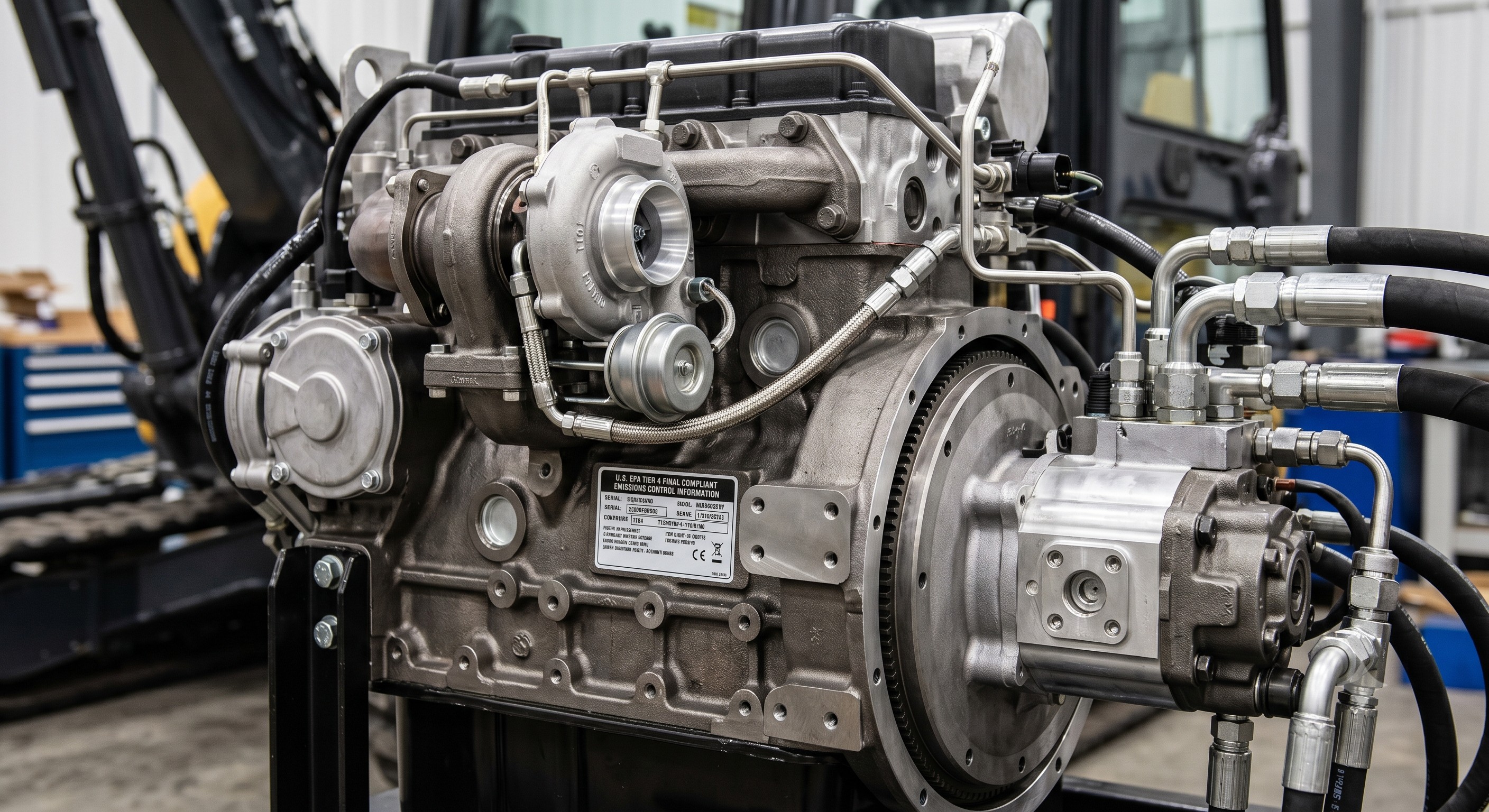
At the heart of a heavy-duty Farming Excavating Machine is a turbocharged diesel engine with 150-250 net horsepower (112-186 kW) at 1,800-2,200 rpm. Tier 4 Final systems utilize DOC+DPF+SCR (diesel oxidation catalyst, diesel particulate filter, selective catalytic reduction) with DEF (diesel exhaust fluid) consumption ≤3-5% of fuel volume. The ISO 8178 C2 cycle certifies 0.02 g/kWh PM (particulate matter) and 0.4 g/kWh NOx—critical for enclosed livestock area operation.
Hydraulic System Architecture
Closed-center, load-sensing hydraulics with variable-displacement axial piston pumps deliver 210-280 bar (3,046-4,060 psi) maximum pressure. Pump flow ranges 180-300 L/min, enabling simultaneous boom lift (≥85 kN breakout force) and 360° swing torque of 35-55 kN·m. Standard ISO 8643 auxiliary circuits support hydraulic thumb, tilt rotator, or a 4-in-1 bucket. Thermal stability is guaranteed with an oil cooler maintaining <80°C under 100% load at 40°C ambient.
Undercarriage & Durability
D7E track chain links (thickness 45-55 mm) with triple-flange track rollers and bolt-on sprockets ensure 8,000-10,000 hour wear life on ROPS/FOPS-certified (ISO 3471/ISO 3449) chassis. Ground pressure: 0.35-0.55 kgf/cm²—low enough for post-harvest fields with minimal rutting. Optional 700 mm wide rubber tracks reduce road transport damage.
Technical Specifications
Baseline performance metrics for a typical 22 t Farming Excavating Machine (CAT 320GF or Komatsu PC210LCi-11 class). All values at 2,000 m altitude, 35°C ambient.
| Key Parameter | Technical Specification (22 t Class Farming Excavator) |
|---|---|
| Engine Net Power | 168 HP (125 kW) @ 2,000 rpm – EPA Tier 4 Final / EU Stage V |
| Operating Weight (with cab & 1.2 m³ bucket) | 22,450 kg (49,490 lb) |
| Maximum Hydraulic Pressure (implement / swing) | 280 bar (4,060 psi) / 240 bar (3,480 psi) |
| Hydraulic Flow (main pumps) | 2 x 145 L/min = 290 L/min total |
| Bucket Breakout Force (ISO 6015) | 98 kN (22,030 lbf) |
| Arm Digging Force (ISO 6015) | 73 kN (16,410 lbf) |
| Fuel Tank Capacity | 410 L (108 gal) |
| Fuel Consumption (average heavy digging) | 13.2 L/h (3.49 gal/h) |
| Max Digging Depth | 6.75 m (22 ft 2 in) |
| Ground Pressure (standard 600 mm triple grouser pads) | 0.44 kgf/cm² (6.26 psi) |
Comparative Advantage: TCO & ROI Analysis
Compared to a 120 hp tractor + backhoe attachment, the dedicated Farming Excavating Machine provides:
Fuel Efficiency: 12-14 L/h vs 18-21 L/h for same material moved (1.2-1.5 m³ per cycle). 5-year fuel saving: ≈28,000 USD (at $0.85/L).
Cycle Time: 18-second full 180° dig-dump-return vs 32 seconds on a 3-point hitch backhoe—43% faster trenching.
ROI Payback: Average payback period = 1,200 operating hours (≈7 months on a 200-hectare vegetable farm with 15 km drainage installation).
Residual Value: After 6,000 hours, machine retains 48-55% of purchase price (vs 35-40% for agricultural tractor attachments).
Heavy-Duty Application Scenarios
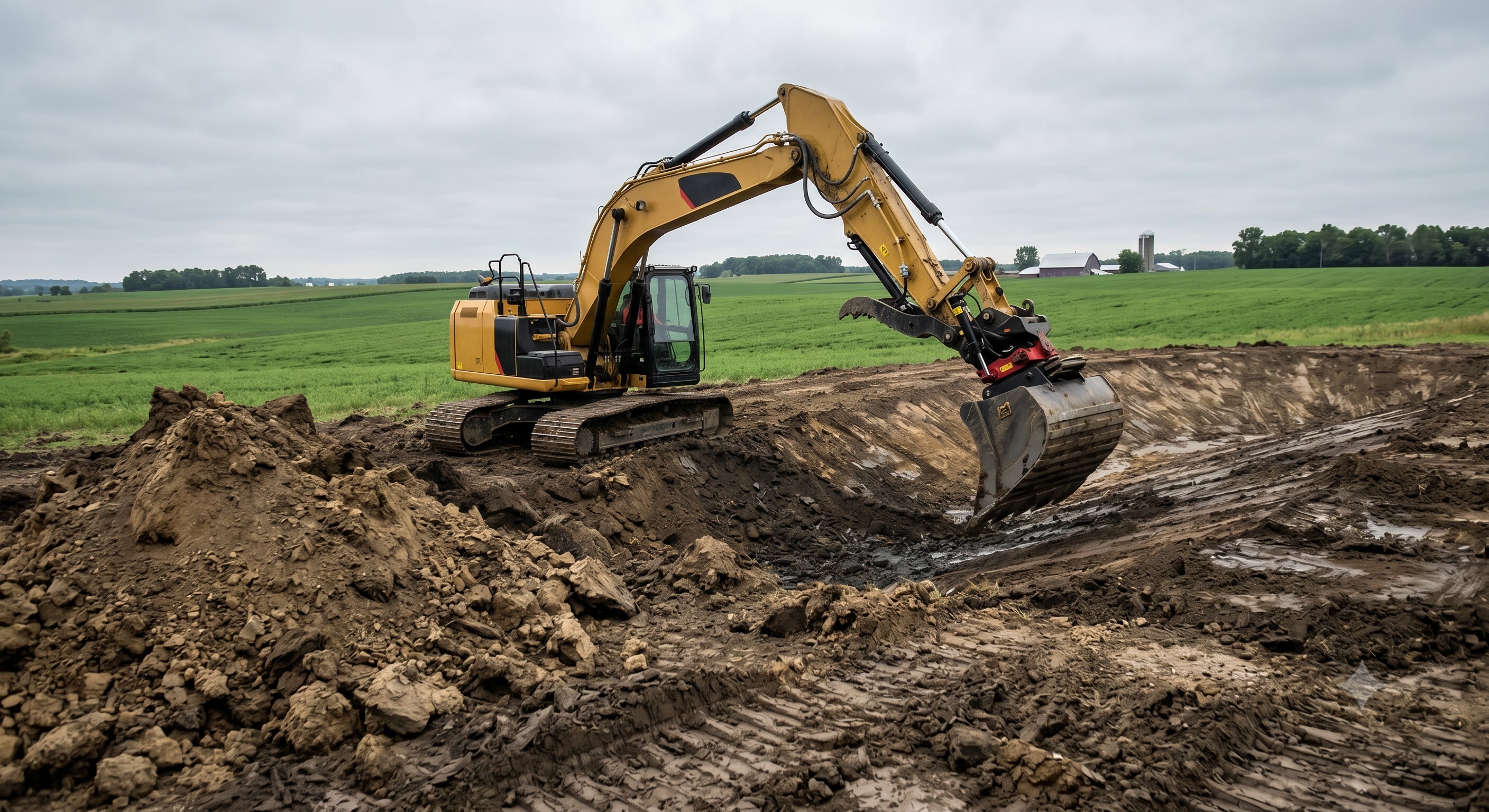
- Precision Drainage & Tiling: Laser/GPS-guided depth control (±2 cm) for subsurface tile lines at 1.2-1.8 m depth—25-30% higher yield in high-water-table fields.
- Manure Lagoon Cleaning: Long-reach boom (8-10 m) with 1.2 m³ heavy-duty bucket removes 5-7 cm hardened crust per pass. Hydrochloric-resistant paint (ASTM B117 tested for 1,000 h salt spray) optional.
- Silage Pit Packing & Unloading: 4-in-1 bucket clamping force >45 kN, unloading a 14 m³ silage trailer in ≤4 minutes.
- Dairy Farm Foundation Excavation: 3,000-5,000 L concrete footings for free-stall barns—ROPS/FOPS cabin with dust pressurization reduces operator fatigue by 35%.
For heavy earthmoving (pond construction, terrace leveling), adding a tiltrotator (e.g., Engcon EC206) increases grade accuracy to 1 cm/m, reducing finish grading time by 50%.
Conclusion
The modern Farming Excavating Machine is no longer a luxury but a data-justified productivity asset. With sub-7-month ROI, compliance with EPA Tier 4 Final / EU Stage V, and a hydraulic system designed for 12,000+ hours of agricultural dust and shock loads, it outperforms converted construction equipment by every metric—fuel L/m³, cycle time, and operator safety. For farms operating >500 hours annually, the shift from a tractor-mounted backhoe to a dedicated excavator yields an average $32,000 net benefit over 5 years. Evaluate your soil conditions, required dig depth, and daily material volume; then match to a machine with ≥10% reserve hydraulic flow for attachments. Industrial productivity starts with the right undercarriage in the right row.