

Introduction
In the demanding world of structural demolition, the efficiency, safety, and profitability of a project are directly tied to the performance of the equipment on-site. While the demolition excavator serves as the backbone of the operation, it is the demolition excavator attachment that acts as the primary tool, dictating the speed and method of dismantling. Selecting the optimal attachment for building demolition is not merely a purchasing decision; it is a strategic engineering choice that impacts timelines, total cost of ownership (TCO), and operational safety. With increasingly stringent environmental regulations, such as EPA Tier 4 Final and EU Stage V emission standards, and the need for precision in urban environments, choosing the right tool for the task is more critical than ever. This guide provides a comprehensive, data-driven analysis of the best attachments for building demolition, offering expert insights into their technical specifications, applications, and comparative advantages.
Primary Demolition Attachments: Breaking and Cutting
Building demolition typically follows a two-phase approach: primary demolition (breaking the structure down) and secondary demolition (processing debris for removal and recycling). Different attachments are optimized for each phase, requiring careful matching to the excavator's hydraulic capacity and the structural material.
Hydraulic Breakers (Hammers)
For primary demolition of concrete, foundations, and masonry, the hydraulic breaker remains the most widely used attachment. These tools convert hydraulic power into high-impact energy, delivering powerful blows to fracture material. Modern breakers, like those from Caterpillar, Komatsu, and Develon, are engineered with sophisticated designs to maximize efficiency . For instance, models like the Develon HB-Series feature a simplified design with charged nitrogen gas to enhance piston stroke energy, while the Komatsu V-Series incorporates energy-recovery valves for increased efficiency and reduced vibration . Proper sizing is critical: a rule of thumb is that the breaker's operating weight should be approximately 8-12% of the carrier machine's operating weight. Additionally, operators must adhere to guidelines, such as repositioning the tool if material doesn't break within 10-15 seconds, to prevent overheating and damage .
Concrete Pulverizers
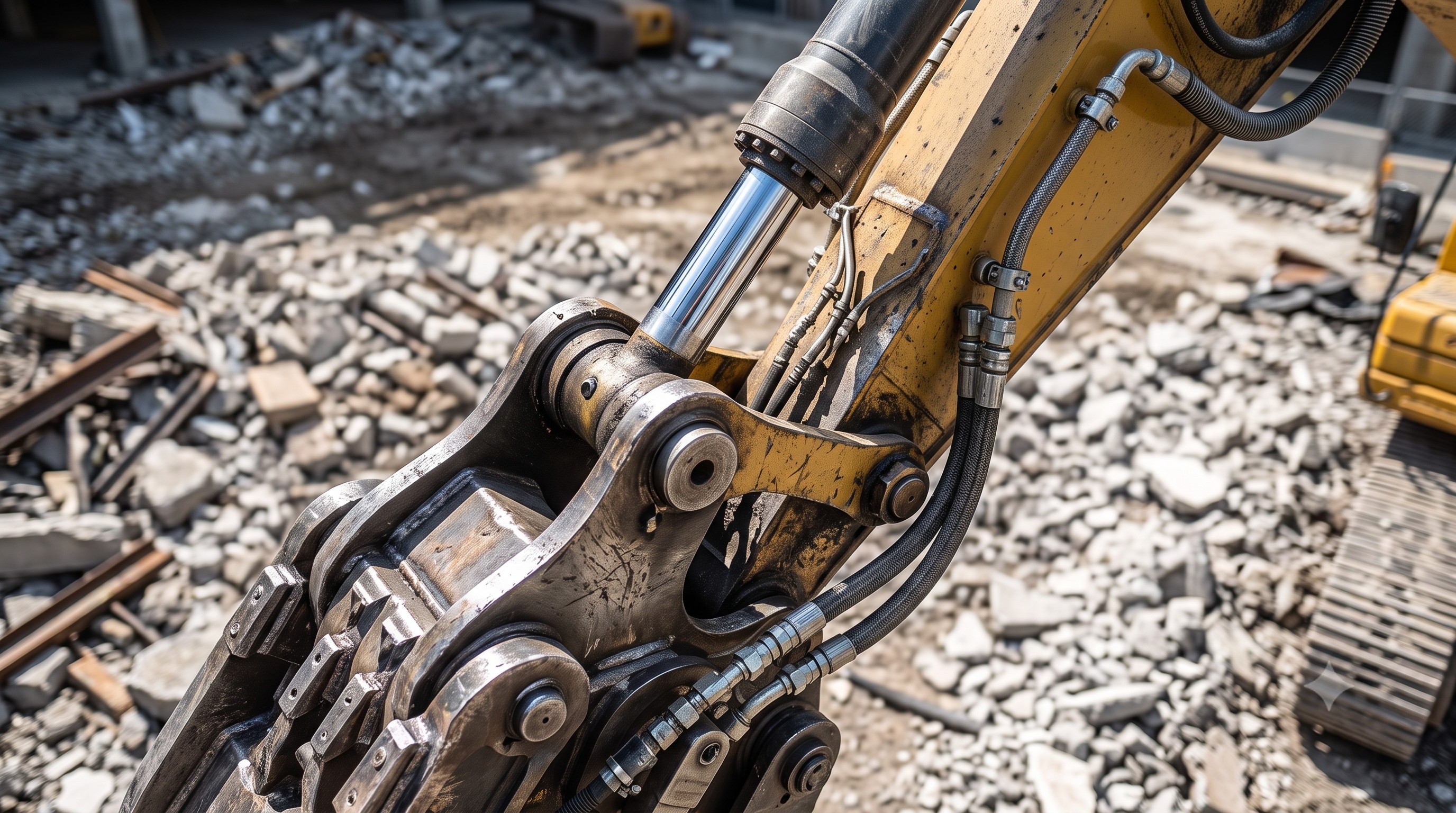
For a more controlled demolition and subsequent material processing, concrete pulverizers are essential. Unlike impact tools, they use immense crushing force generated by hydraulic cylinders to break down concrete while simultaneously separating reinforcing steel. This makes them invaluable for secondary demolition and recycling. High-end pulverizers from MB Crusher and NPK feature interchangeable jaw kits for primary crushing and secondary pulverizing, and some, like the MB-PT series, offer 360-degree continuous rotation for precise positioning . Models like the NPK V250R can deliver a crushing force of 229,500 lbf, suitable for excavators in the 24-25 metric ton range . The use of Hardox steel construction in many premium models ensures extreme durability against the high-stress demands of building demolition.
Hydraulic Shears
When the structure involves significant steel components, such as beams, rebar, and pipes, hydraulic shears are the attachment of choice. These tools use a powerful shearing action to cut through metal, replacing dangerous and less efficient methods like torch cutting. Manufacturers like Genesis, LaBounty, and ShearCore produce severe-duty shears for a range of excavator sizes. The LaBounty MSD Legend Series, for example, is designed for applications ranging from bridge deconstruction to industrial demolition and features improved power-to-weight ratios . For heavy-duty tasks, the ShearCore Fortress FC95 is a specialized attachment designed for the toughest concrete processing applications, boasting a jaw opening of 65 inches and weighing 21,000 pounds, suitable for excavators over 100,000 pounds . Proper installation is vital; Genesis notes that correct hydraulic line routing is crucial to prevent extra pressure requirements and increased fuel consumption .
Material Handling and Processing Attachments
Once the primary structure is broken down, the focus shifts to debris handling, sorting, and processing. The right attachments here can significantly reduce project timelines and increase revenue from recycled materials.
Demolition Grapples
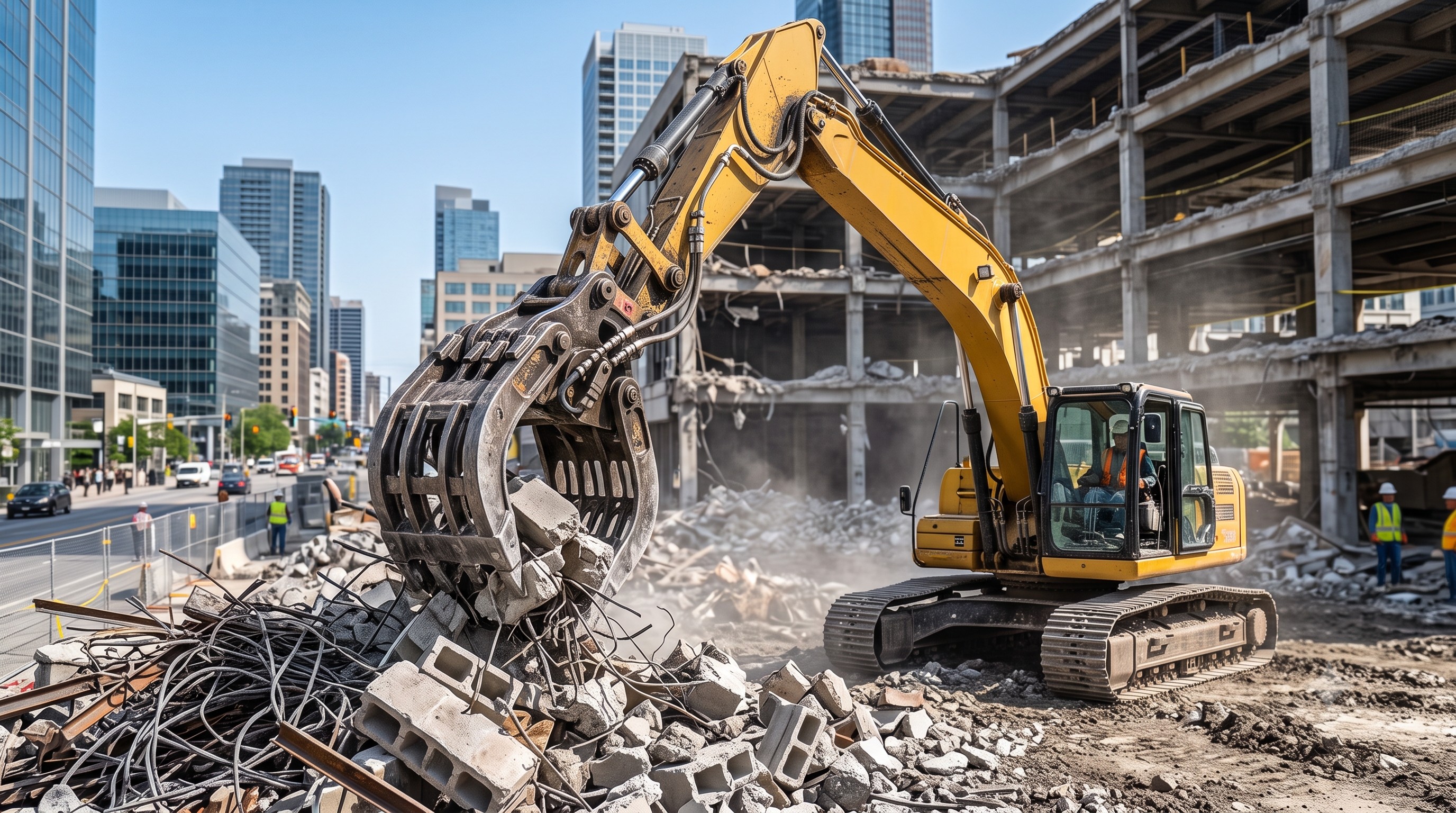
Demolition and sorting grapples are designed for the efficient handling of debris . These hydraulic claws allow operators to pick up, rotate, and set down large volumes of rubble, significantly speeding up cleanup. Models like the Caterpillar Contractor's Grapple are designed to turn an excavator into a high-efficiency debris handling machine, offering better control than a standard bucket and thumb for sorting materials like concrete from wood and scrap metal . Manufacturers like Werk-Brau offer customizable wide-mouth box-style grapples with various tine configurations to match specific job site requirements .
Rippers
For preparatory work and selective demolition, a ripper tooth offers a low-vibration alternative to hydraulic breakers . By concentrating the excavator's breakout force onto a single, pointed tooth, it can effectively tear up concrete slabs, asphalt, and frozen ground, exposing rebar and creating cracks in the material. This controlled pre-breaking reduces collateral damage and is particularly useful in vibration-sensitive areas . As a preparatory tool, it pairs effectively with concrete pulverizers, which can then crush the already weakened material and extract reinforcement.
Technical Specifications and Selection Criteria
Selecting the appropriate attachment requires a detailed analysis of its technical specifications and compatibility with the carrier machine. Key parameters include the excavator's operating weight, hydraulic flow (gallons per minute, GPM), and operating pressure (PSI). An attachment that is too heavy can compromise the machine's stability, while insufficient hydraulic flow will result in slow cycle times and reduced efficiency . The table below illustrates the technical landscape for a class of medium-duty demolition pulverizers.
| Key Parameter | Technical Specification |
|---|---|
| Primary Function | Concrete Crushing & Rebar Separation |
| Carrier Weight Class | 13,228 - 55,116 lbs (6 - 25 metric tons) |
| Structure | Hardox Steel Construction, 360° Continuous Rotation |
| Interchangeable Jaws | Crusher, Pulverizer, Shear |
| Max Crushing Force | Example: NPK V250R at 229,500 lbf |
| Hydraulic Flow Requirement | 26 - 66 GPM (Varies by model) |
Comparative Advantage and ROI
Investing in premium attachments like multi-functional pulverizers or high-performance shears can deliver a compelling return on investment (ROI). By enabling one machine to perform multiple tasks (e.g., primary crushing, secondary pulverizing, and steel separation), contractors can reduce their fleet size, lower transport and maintenance costs, and accelerate job completion . Furthermore, attachments that effectively process material on-site, such as crusher buckets or pulverizers, allow contractors to recycle concrete for backfill or aggregate, creating a new revenue stream and reducing landfill costs . The use of durable materials like Hardox steel and features like reversible cutting edges significantly reduce maintenance downtime, further enhancing productivity.
Heavy-Duty Application Scenarios
The versatility of modern demolition attachments allows them to be deployed across a variety of heavy-duty projects, ensuring the right tool is always available for the task at hand.
Structural Building Demolition
In high-reach building demolition, a specialized high-reach demolition excavator equipped with a combination of attachments is key to efficiency and safety . Operators typically use a hydraulic hammer for the initial top-down breakdown of concrete and steel frames. Following this, concrete pulverizers and steel shears work in tandem to process the debris, while grapples ensure safe and rapid cleanup from the ground level .
Recycling and Scrap Processing
Post-demolition, sites transform into recycling and scrap processing hubs. Here, attachments are the primary tools for revenue generation. Concrete pulverizers crush concrete into reusable aggregate and separate clean scrap rebar, while hydraulic shears cut steel beams and pipes into manageable lengths for transport to recycling facilities . For this role, multi-functional attachments like Epiroc Combi Cutters, which allow for quick jaw changes between cutting and crushing, are particularly effective .
Urban and Confined-Space Projects
In urban demolition, strict limits on noise, vibration, and dust are paramount. Low-vibration methods such as using a ripper tooth or splitting tools are preferred for initial material loosening . Rotary cutters, like Caterpillar's RC series, are also ideal for confined spaces; they provide controlled, high-precision cutting with significantly less noise than hydraulic hammers . This selective deconstruction approach minimizes disruption to surrounding structures and infrastructure.
Conclusion
The landscape of building demolition is evolving, driven by the need for safer, faster, and more sustainable demolition practices. The success of any project hinges on the strategic selection and application of the right demolition excavator attachments. From the raw power of hydraulic breakers for primary demolition to the precision of shears and pulverizers for material processing, each attachment plays a vital role in the workflow. By carefully matching the attachment's specifications to the carrier machine and the project's unique requirements, contractors can maximize productivity, significantly reduce TCO, and enhance their competitive edge. Forging partnerships with reputable manufacturers like Cat, Volvo, MB Crusher, and Genesis ensures access to the latest technologies and expert support needed to tackle the most demanding industrial challenges .