
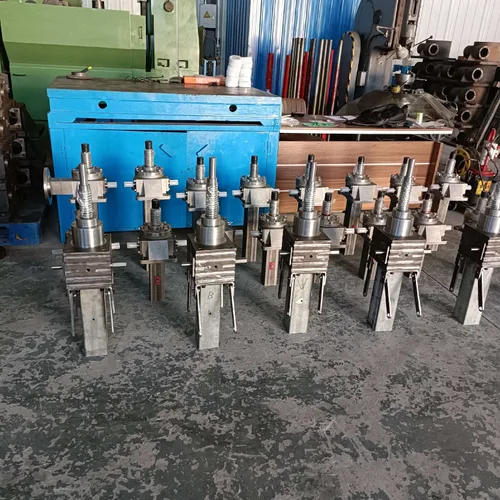
Stainless Steel Screw Jack
Min. Order: 1 Pieces
- bearing capacity:
- 25kN, equivalent to 2.5 tons
- Lead Time:
- 15‑30 days after receipt of deposit
- Supply Ability:
- 1,000 Pieces
- Shipping Port:
- Tianjin Port/Shanghai port

Product Features & Applications
Screw lift (also known as spiral screw lift) is a mechanical transmission device that converts the rotational motion of a motor into linear lifting motion. It is mainly composed of a worm gear reduction mechanism and a screw nut mechanism, completely eliminating dependence on hydraulic oil. It has the characteristics of compact structure, small volume, and strong load-bearing capacity, and is often referred to as the "precision strongman" in the industrial field.
Core working principle
The power source (such as a motor or handwheel) drives the worm to rotate, and the worm drives the worm wheel to rotate. Due to the presence of internal threads in the inner cavity of the worm gear, which mesh with the external threads of the screw, the rotational motion of the worm gear is converted into axial linear motion of the screw (or nut). Thanks to the large reduction ratio of the worm gear, it can drive objects to perform heavy-duty linear motion with very little input torque.
Comparison of Common Types
According to the different internal screw transmission methods, there are mainly two types:
Trapezoidal screw lift
Features: Relying on sliding friction transmission, with natural self-locking function, the load will not drop after power failure.
Advantages and disadvantages: The structure is simple and the cost is low, but the transmission efficiency is relatively low (about 30%~50%).
Applicable scenarios: High load, low-frequency operation, low-speed heavy-duty situations with high safety requirements (such as gate opening and closing, heavy equipment positioning).
Ball screw elevator
Features: By using ball rolling instead of sliding friction, the transmission efficiency is extremely high (up to 90% or more).
Advantages and disadvantages: Fast running speed, low heat generation, long lifespan, and extremely high precision, but it does not have self-locking properties and requires additional installation of braking devices.
Applicable scenarios: High speed, high-frequency start stop, automated production lines and CNC machine tools that require strict positioning accuracy.
Technical Specifications
- bearing capacity
- 25kN, equivalent to 2.5 tons
Trade Specifications
- Reference Price
- USD $1.00 - $500.00
- Minimum Order Quantity
- 1 Pieces
- Lead Time
- 15‑30 days after receipt of deposit
- Supply Ability
- 1,000 Pieces
- Shipping Port
- Tianjin Port/Shanghai port

Dezhou Darui Machinery Equipment Co., Ltd.
Dezhou Darui Machinery Equipment Co., Ltd. is a professional manufacturer integrating speed reducers and transmissions. Our main products include various types of reducers such as screw jacks, worm gear screw jacks, spiral screw jacks, and ball screw jacks. With over a decade of development, supported by government departments and valued customers, we have grown steadily based on rigorous scientific management, strong technical capabilities, and a stable sales network. By prioritizing product quality and credibility, we have been awarded as a "Contract-Honoring and Trustworthy Enterprise" and "AAA Credit Enterprise". Currently, tens of thousands of our reducers and transmissions are operating reliably in machinery across 29 provinces, municipalities and autonomous regions in China, winning trust and praise from hundreds of users, and our products are widely promoted nationwide. Never satisfied with the status quo, Dezhou Darui keeps up with market trends and technological advances, developing diversified and serialized products. With the ambition to build a domestic foundation and expand into the international machinery industry, we aim to serve customers better. We would like to express our sincere gratitude to all new and existing customers, as well as friends from all sectors who care about our product development and quality improvement. Our corporate goal and mission: to keep pace with the world in the transmission machinery field and build China's No.1 reducer brand.
- Location
- No. 88 Fusheng Road, Tianqu Industrial Park, Dezhou City, Shandong Province
- Main Products
- Screw Jack, Ball Screw Jack, Electric Actuator
- Employees
- Less than 50 People
- Factory Area
- 1,000-5,000 m²
- Annual Revenue
- US$1 Million - US$5 Million
- Main Markets
- Southeast Asia / South Asia / Middle East & North Africa / Africa