
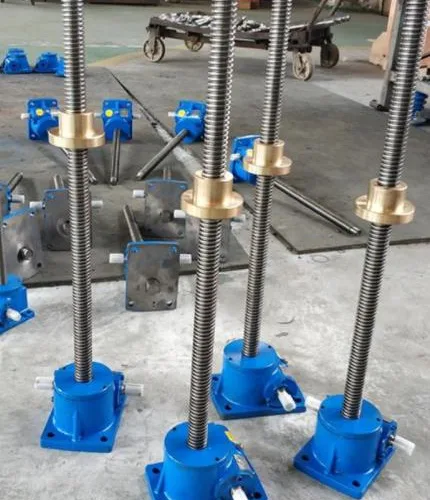
Screw lift, SWL series worm screw lift is a basic lifting component
Model: SWL
Min. Order: 1 Pieces
- Lead Time:
- 10 days after deposit
- Supply Ability:
- 9,999 Pieces per Week
- Shipping Port:
- Shanghai Port/Tianjin Port

Product Features & Applications
Brief Introduction of Worm Gear Screw Jack The worm gear screw jack is a versatile mechanical lifting device designed for linear lifting, pushing, tilting, and height adjustment. It adopts worm and worm gear transmission structure, featuring compact size, stable operation, simple installation and low maintenance cost, which is widely applied in mechanical manufacturing, automation equipment, metallurgy, construction, logistics and other industries.
1. Screw Type Classification
1.1 Trapezoidal Screw Jack
1.2 Ball Screw Jack
2. Core Selection Parameters (Mandatory)
2.1 Load Capacity (Thrust / Tension)
-
Conventional working condition: Safety factor ≥ 1.5
-
Impact & frequent start-stop working condition: Safety factor 1.8 - 2.5
-
High-risk load-bearing scenario: Safety factor ≥ 2.0
2.2 Lifting Stroke
2.3 Lifting Speed
-
Trapezoidal screw: Recommended linear speed ≤ 2.5m/min, not suitable for high-speed operation
-
Ball screw: Support linear speed 5-10m/min for high-speed operation
2.4 Reduction Ratio
-
Large reduction ratio: High output torque, low speed, suitable for heavy-duty lifting
-
Small reduction ratio: Fast operating speed, low torque, suitable for light-load and high-efficiency scenarios
2.5 Duty Cycle
-
Intermittent short-time work: Adopt trapezoidal screw jack (conventional standard)
-
High-frequency continuous work: Prioritize ball screw jack, verify thermal power to prevent housing overheating and damage
3. Installation Methods
-
Base Mounting: Installed with bottom flange, screw extension lifting (the most widely used type)
-
Flange Mounting: Output through top flange, suitable for limited installation space
-
Trunnion Mounting: Articulated swing structure, applicable for tilting and flipping mechanisms
-
Nut Travel Type: Screw rod fixed without rotation, nut moves up and down to save installation space
4. Optional Accessories & Functional Configurations
-
Safety Nut: Real-time wear monitoring and early warning, realizing safety protection for key equipment
-
Limit Switch: Upper and lower travel limit protection to avoid over-travel damage
-
Encoder / Potentiometer: Precise position feedback for closed-loop control and multi-unit synchronous operation
-
Protective Bellows: Dustproof and waterproof, suitable for harsh working environments
-
Driving Mode: Hand crank, ordinary motor, brake motor, servo motor, variable frequency motor
-
Multi-unit Synchronous System: Linked by transmission shaft to realize synchronous lifting of multiple jacks
5. Required Information for Model Selection
-
Required load capacity (Ton)
-
Effective lifting stroke (mm)
-
Required lifting speed (mm/min)
-
Screw type: Trapezoidal screw / Ball screw
-
Installation method & angle: Vertical / Horizontal / Inclined
-
Working mode: Intermittent / Continuous operation
-
Driving type: Handwheel / Ordinary motor / Servo motor / Brake motor
-
Optional accessories: Limit switch / Safety nut / Encoder / Protective bellows
-
Working environment: Indoor / Outdoor, dust, corrosion and other special conditions
6. Selection Precautions
-
Do not select models only by static rated load. Screw stability and thermal power under actual stroke must be verified.
-
Ball screw jack has no self-locking function. Brake motor is a must for vertical load-bearing applications to prevent falling.
-
Screw jacks are only applicable for pure axial force bearing. External guiding structure is required if lateral force exists.
-
For multi-jack linkage system, the linkage coefficient shall be considered, and the single jack load specification needs to be appropriately enlarged.
Trade Specifications
- Reference Price
- USD $1.00 - $500.00
- Minimum Order Quantity
- 1 Pieces
- Lead Time
- 10 days after deposit
- Supply Ability
- 9,999 Pieces per Week
- Shipping Port
- Shanghai Port/Tianjin Port

Dezhou Darui Machinery Equipment Co., Ltd.
Dezhou Darui Machinery Equipment Co., Ltd. is a professional manufacturer integrating speed reducers and transmissions. Our main products include various types of reducers such as screw jacks, worm gear screw jacks, spiral screw jacks, and ball screw jacks. With over a decade of development, supported by government departments and valued customers, we have grown steadily based on rigorous scientific management, strong technical capabilities, and a stable sales network. By prioritizing product quality and credibility, we have been awarded as a "Contract-Honoring and Trustworthy Enterprise" and "AAA Credit Enterprise". Currently, tens of thousands of our reducers and transmissions are operating reliably in machinery across 29 provinces, municipalities and autonomous regions in China, winning trust and praise from hundreds of users, and our products are widely promoted nationwide. Never satisfied with the status quo, Dezhou Darui keeps up with market trends and technological advances, developing diversified and serialized products. With the ambition to build a domestic foundation and expand into the international machinery industry, we aim to serve customers better. We would like to express our sincere gratitude to all new and existing customers, as well as friends from all sectors who care about our product development and quality improvement. Our corporate goal and mission: to keep pace with the world in the transmission machinery field and build China's No.1 reducer brand.
- Location
- No. 88 Fusheng Road, Tianqu Industrial Park, Dezhou City, Shandong Province
- Main Products
- Screw Jack, Ball Screw Jack, Electric Actuator
- Employees
- Less than 50 People
- Factory Area
- 1,000-5,000 m²
- Annual Revenue
- US$1 Million - US$5 Million
- Main Markets
- Southeast Asia / South Asia / Middle East & North Africa / Africa