
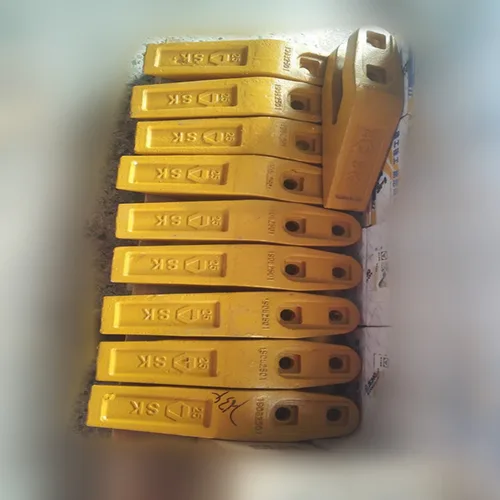
Bucket Tooth 252117634 | Z5GN.30-5, XCMG Loader Bucket Ground Engaging Tool
Min. Order: 1 Pieces
- Material code::
- 252117634
- Material Description::
- Z5GN.30-5 bucket teeth

Product Features & Applications
This Bucket Tooth 252117634 is a cutting wear part in the bucket working device of XCMG loaders, associated with drawing number Z5GN.30-5. Loader bucket teeth are the main wear parts of a loader, consisting of a tooth holder and a tooth tip joined by a pin—wear and failure occur mainly at the tooth tip, so only the tip needs replacement after wear .
A bucket tooth (also called shovel tooth, bucket tip, or ground engaging tool) is the core cutting wear part at the front edge of a loader bucket—equivalent to the loader's "teeth"—directly contacting soil, rock, ore, construction debris, and other materials to undertake the core tasks of digging, penetration, scraping, and breaking . A loader bucket tooth typically consists of two parts: a tooth holder (shank) and a tooth tip (point), joined and fixed by a pin; since wear and failure during operation occur mainly at the tooth tip, routine maintenance only requires replacing the tip while the holder can be used long-term .
Working-mechanism of bucket teeth in loading operations (based on public literature on construction-machinery design, as background reference for this part, not specific to this item):
-
Reducing penetration resistance: When the bucket edge is fitted with bucket teeth, the teeth penetrate the material pile before the cutting edge; because the teeth have a small contact area and high specific pressure, they penetrate the pile more easily than a toothless cutting edge, reducing insertion resistance by about 20%—especially significant when loading high-density, high-resistance materials .
-
Protecting the bucket body: As wear parts, bucket teeth bear the main abrasion and impact, preventing the bucket's front-edge blade from direct erosion and greatly extending the bucket's overall service life .
-
Improving operational precision: The pointed-penetration characteristic of bucket teeth gives the operator a clear reference baseline in fine operations, facilitating control of loading depth and angle .
Classification and selection by working condition (as general background, not specific to this part):
By operating environment, bucket teeth are generally divided into three categories: rock teeth (for high-abrasion hard-rock conditions such as iron mines and quarries), earth-moving teeth (for conventional earthwork such as soil and sand-gravel), and conical teeth (for specific materials such as coal mines); bucket-tooth shapes also vary by loader brand . By tooth-tip cross-section, common designs in the market include chisel tooth, rock chisel, single tiger-tooth, and double tiger-tooth variants—chisel teeth have a wide working face, good wear resistance, and leave a flat bottom in grading work, suiting general transport, grading, and trenching; rock chisels offer strong penetration, suiting hard-rock breaking .
Material and process differences: By manufacturing process, bucket teeth are mainly divided into cast teeth and forged teeth—forged teeth are generally more wear-resistant and harder, with a service life about twice that of cast teeth, while priced at about 1.5 times that of cast teeth . High-manganese steel (e.g., ZGMn13) has extremely strong wear resistance and a work-hardening effect, suiting hard rock and sand-gravel; alloy steel (e.g., 45#, 65Mn) has good toughness and impact resistance, suiting earthwork and loose materials . Tooth-tip hardness typically ranges from HRC 47–54 or HB 300–500, requiring a trade-off between wear resistance and impact resistance based on working conditions .
Technical Specifications
- Material code:
- 252117634
- Material Description:
- Z5GN.30-5 bucket teeth
Trade Specifications
- Reference Price
- USD $25.00
- Minimum Order Quantity
- 1 Pieces

Xuzhou Hengming Machinery Equipment Co., Ltd.
Rooted in Xuzhou, the birthplace of XCMG brand and the core national industrial cluster for construction machinery, Xuzhou Hengming Machinery Equipment Co., Ltd. has long focused on the supporting spare parts industry for XCMG construction machinery. We hold official import and export business qualifications, and serve as a one-stop source supplier of spare parts for global XCMG equipment users.
- Location
- Room 115, D32# Block 1, Huaihai Hardware & Electromechanical Market, East Sanhuan Road, Xuzhou Economic & Technological Development Zone, Jiangsu Province, China
- Main Products
- Full range of XCMG original spare parts
- Employees
- Less than 50 People
- Factory Area
- 1,000-5,000 m²
- Annual Revenue
- US$1 Million - US$5 Million
- Main Markets
- Europe / Middle East & North Africa / Africa